
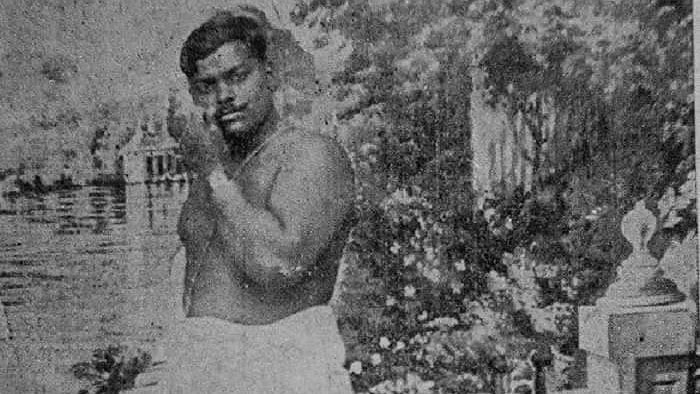
1. Early Life and Background Of Chandra Shekhar Azad
Chandra Shekhar Azad was born on July 23, 1906, in the village of Bhavra, located in the Alirajpur district of present-day Madhya Pradesh, India. His father, Pandit Sitaram Tiwari, was a poor but honest man, and his mother, Jagrani Devi, had a deep desire to make her son a scholar. She sent young Chandra Shekhar to Varanasi (then Benares) for education, where he studied Sanskrit in a traditional pathshala and later at the Kashi Vidyapeeth.
Table of Contents
ToggleWhile in Varanasi, Azad came into contact with the ideas of Indian nationalism. The Jallianwala Bagh massacre of 1919 and the growing unrest in the country deeply influenced his young mind. At the age of just 15, he joined Mahatma Gandhi’s Non-Cooperation Movement in 1921.
When he was arrested by the British for participating in the movement, he gave his name as “Azad” (meaning “Free”), his father’s name as “Swatantrata” (meaning “Freedom”), and his residence as “Jail.” From that day on, he became known as Chandra Shekhar Azad, a name he lived by for the rest of his life. (click here)
2. Revolutionary Activities | Hindustan Socialist Republican Association (HSRA)
Although initially inspired by Gandhi’s philosophy of non-violence, the suspension of the Non-Cooperation Movement after the Chauri Chaura incident in 1922 left Azad disillusioned. He believed that true freedom could not be achieved without armed resistance. He soon joined the revolutionary organization Hindustan Republican Association (HRA), which aimed to overthrow British rule through direct action.
Under the mentorship of Ram Prasad Bismil, Azad learned the art of guerrilla tactics, weapons handling, and underground movement. He was committed to the cause of Indian independence and took a solemn pledge that he would never be caught alive by the British police.
Azad became a key figure in the HRA, which was later reorganized as the Hindustan Socialist Republican Association (HSRA) in 1928. This reorganization, led by Bhagat Singh, Sukhdev, Rajguru, and Azad himself, was aimed at combining revolutionary activities with socialist ideas to build a free and just Indian society.(Outbound link)
3. Major Role in Revolutionary Actions| Kakori conspiracy
One of the most well-known events involving Chandra Shekhar Azad was the Kakori Train Robbery of 1925. The revolutionaries planned and executed the robbery of a train near Kakori, Uttar Pradesh, to secure funds for their organization. Although the act was successful in terms of money, it led to the arrest and execution of several revolutionaries, including Bismil and Ashfaqulla Khan.
Azad managed to escape and continued his underground work, evading arrest for years. He also played a key role in avenging the death of Lala Lajpat Rai, who had been injured during a police lathi charge and later died. Azad, along with Bhagat Singh and others, plotted the assassination of Superintendent James Scott, the officer responsible. However, they mistakenly killed J.P. Saunders instead, in Lahore in 1928.
Azad was deeply connected to Bhagat Singh and remained in close contact with him throughout their revolutionary journey. After Bhagat Singh’s arrest in 1929, Azad continued to organize secret meetings, raise funds, and plan future activities to keep the freedom struggle alive.
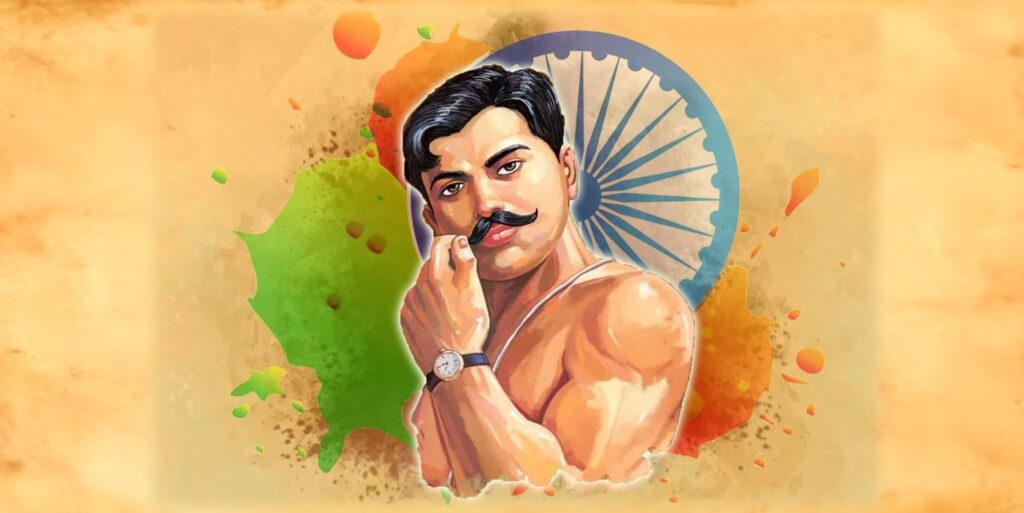
4. Martyrdom and Remembering the Hero | Allahabad Alfred Park (now Azad Park)
On February 27, 1931, Chandra Shekhar Azad was betrayed and surrounded by British police in Alfred Park (now Azad Park) in Allahabad. After a fierce gun battle, when he found himself outnumbered and nearly out of ammunition, Azad chose to shoot himself rather than be captured alive. True to his pledge, he died free, not in British custody.
His martyrdom sent shockwaves across the nation. People, especially the youth, were inspired by his courage and selflessness. Azad became a legend, and his life story continued to motivate future generations of freedom fighters.
Today, is remembered as one of India’s greatest revolutionaries. Statues and parks in his name exist across India, and his sacrifice is honored in textbooks, films, and patriotic songs.
Chandra Shekhar Azad lived a short but impactful life. He was not just a fighter with a gun but a visionary who dreamed of a free, equal, and just India. His bravery, determination, and undying spirit continue to inspire Indians even today. He truly lived up to his name—Azad—and remains one of the most respected heroes of the Indian independence movement.